 Rio Rancho Stucco Repair
 Restucco & Recoating in Rio Rancho
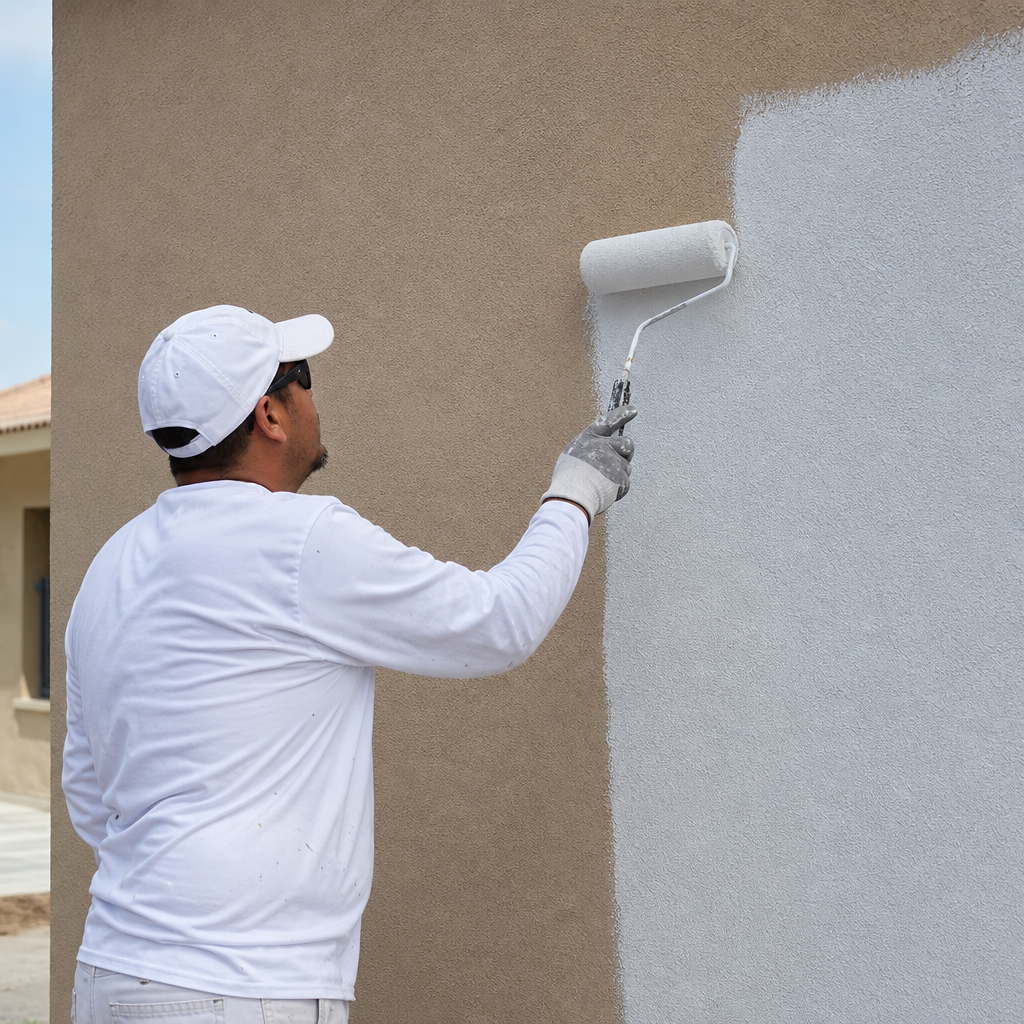
Restucco and recoating renew a stucco exterior that’s past patching: faded, chalky, map-cracked, or carrying decades of mismatched repairs. In Rio Rancho, a recoat runs $3–$6 per square foot over a sound base, and a full restucco runs $6–$9 per square foot ($10–$14 for smooth Santa Fe finishes), with whole-house jobs commonly landing $12,000–$20,000. Send photos of your walls and get an honest read on which one your house actually needs. They are not the same job, and plenty of homes get sold the expensive one unnecessarily.
Recoat vs. restucco vs. fog coat: the honest taxonomy
Fog coat, a pigmented cement slurry sprayed over sound, unpainted stucco to renew color only. No texture change, no crack bridging. The cheapest refresh there is, and the right call more often than contractors admit, especially for blending after a patch repair on one elevation.
Recoat, a new finish coat troweled over existing base coats that are still solid and well-bonded. Restores color and texture, buries fine map-cracking, unifies a wall with patch history. $3–$6/sq ft. This is what most “my stucco looks terrible” houses in Rio Rancho actually need.
Full restucco, tear back to (or rebuild) the base system, then new coats throughout. Required when base coats are delaminating in large areas, the lath and paper have failed, or the wall is past the point where a finish coat has anything sound to grip. $6–$9/sq ft standard, $10–$14 smooth. This is the right job less often than it gets sold. The wall tells the truth when you sound it, and we do that before quoting.
The deciding question isn’t how bad the wall looks. It’s how much of it is still bonded. A hideous but solid wall recoats beautifully. A decent-looking wall that thuds hollow across a third of its area is a restucco candidate no matter how the color reads.
Why Rio Rancho walls get here
High-altitude UV is merciless on color coats. At ~5,300 feet the sun degrades pigmented finish coats faster than at lower elevations, south- and west-facing walls fade first and hardest. When the color rubs off chalky on your palm, the binder is spent. That’s the classic 1990s-production-home condition across Enchanted Hills, Northern Meadows, and the Golf Course corridor: structurally fine one-coat walls wearing a dead finish.
Map-cracking accumulates. Daily 30–40°F temperature swings and winter freeze-thaw craze the finish coat over the years. Individual crack repair stops making sense when the pattern covers whole elevations, a recoat (or an elastomeric coating, if you want flexibility and waterproofing more than a cement finish) resets the whole surface at once.
Patch archaeology. The original Rio Rancho Estates homes from the 1960s–80s often carry forty years of repairs in six textures and four colors. Each patch was fine; together they read like a quilt. A recoat is the unification move: one texture, one color, one wall again.
The pueblo-style problem. Flat-roof homes with parapets fail from the top down. If your walls need recoating and your parapet caps are cracked, the caps get fixed first, recoating over an active leak wastes the recoat. We check; see parapet repair.
What the job includes
- Sounding and repair scoping. Every elevation tapped out. Hollow areas, open cracks, and failed patches are cut out and rebuilt first, a recoat locks in whatever’s under it, so what’s under it has to be right.
- Cause corrections. Canale flashing, sprinkler adjustment, sealant joints at windows and penetrations. The recoat should be the last thing water touches, not the first thing it defeats.
- Prep. Surfaces cleaned; painted or sealed walls get bonding treatment or an acrylic-system plan. Masking of windows, fixtures, roofing, and flatwork.
- Base work where needed. In restucco areas: new paper lapped correctly, new galvanized lath, scratch and brown coats moist-cured before anyone thinks about finish.
- Finish coat. Your choice of texture (sand float, skip trowel, or smooth Santa Fe) in an integrally colored cement finish or acrylic. Color decisions get judged on a dry sample panel in daylight, because cement finishes shift color as they cure.
- Cure and walk-through. Final color and texture reviewed dry, in sun, with you.
Note on permits: the City of Rio Rancho’s Building Division says permits apply to most repair and remodel work on a house exterior, so expect a recoat or restucco to need one. It’s routine, and it’s itemized in the quote rather than buried.
What it costs
| Job | Range |
|---|---|
| Fog coat / color coat, one elevation | priced by area (recoat range) |
| Recoat, one or two elevations | $3,000–$8,000 |
| Recoat, whole house | $3–$6/sq ft of wall area |
| Full restucco, standard finish | $6–$9/sq ft |
| Full restucco, smooth Santa Fe / specialty | $10–$14/sq ft |
| Whole-house restucco, typical | $12,000–$20,000 |
A typical 2,000 sq ft single-story Rio Rancho home carries roughly 1,800–2,400 sq ft of stucco wall area, multiply honestly and the ranges above hold. Two-story homes, heavy repair prep, painted substrates, and specialty finishes move you up within the range. Full context on the pricing page.
Timing and the freeze rule
Cement coats need moist curing at above-freezing temperatures, and Rio Rancho winter nights freeze regularly. So restucco season here is realistically spring through fall, and the best jobs are scheduled, not squeezed. Spring recoats also mean your renewed wall meets the July–September monsoon fully cured. If you’re planning around a home sale or an HOA notice, build in the two-week job window plus scheduling lead time; winter is the right season to get quoted and on the calendar.
Send wide photos of each elevation plus close-ups of the worst areas, and note whether the walls have ever been painted. You’ll get back the recoat-vs-restucco verdict with numbers for each, so the decision is yours with real information. We cover Rio Rancho, Corrales, Bernalillo, Placitas, and Albuquerque, and if all your wall really needs is a fog coat, that’s what we’ll tell you.
Frequently Asked Questions
What does restucco cost in Rio Rancho?
A recoat (new finish coat over a sound base) runs $3–$6 per square foot; full restucco runs $6–$9 per square foot at standard finishes, $10–$14 for smooth Santa Fe-style. Whole-house restucco commonly lands $12,000–$20,000; one or two elevations $3,000–$8,000. System, height, and prep drive where you land.
What's the difference between a recoat and a full restucco?
A recoat adds a new finish coat (or fog coat) over base coats that are still sound, it renews color and texture. A full restucco tears back further and rebuilds the coat system, used when base coats are delaminating or the wall has been patched past saving. We sound the wall and tell you honestly which one it needs.
Is my faded, chalky stucco a candidate for recoating?
Usually yes. Chalking, color rubbing off on your hand, means the finish coat's binder has been cooked off by UV, which is cosmetic-to-early-functional failure. If the base is solid and hollow spots are minor, a recoat restores the wall for roughly half the cost of restucco. Widespread hollow areas change the answer.
Can you recoat over paint?
Painted stucco complicates a cement recoat. The new coat needs a bondable surface, so paint means extra prep, bonding agents, or a shift to an acrylic finish or elastomeric system instead. It's a common situation in older Rio Rancho neighborhoods and it's quotable from photos; it just has to be planned, not discovered.
How long does a whole-house restucco take?
Typically one to two weeks: repairs and prep, then scratch/brown work where needed, cure time, then finish coat. Cement coats need moist curing and above-freezing temperatures, so jobs are scheduled spring through fall in Rio Rancho.