 Rio Rancho Stucco Repair
 Stucco Crack Repair in Rio Rancho
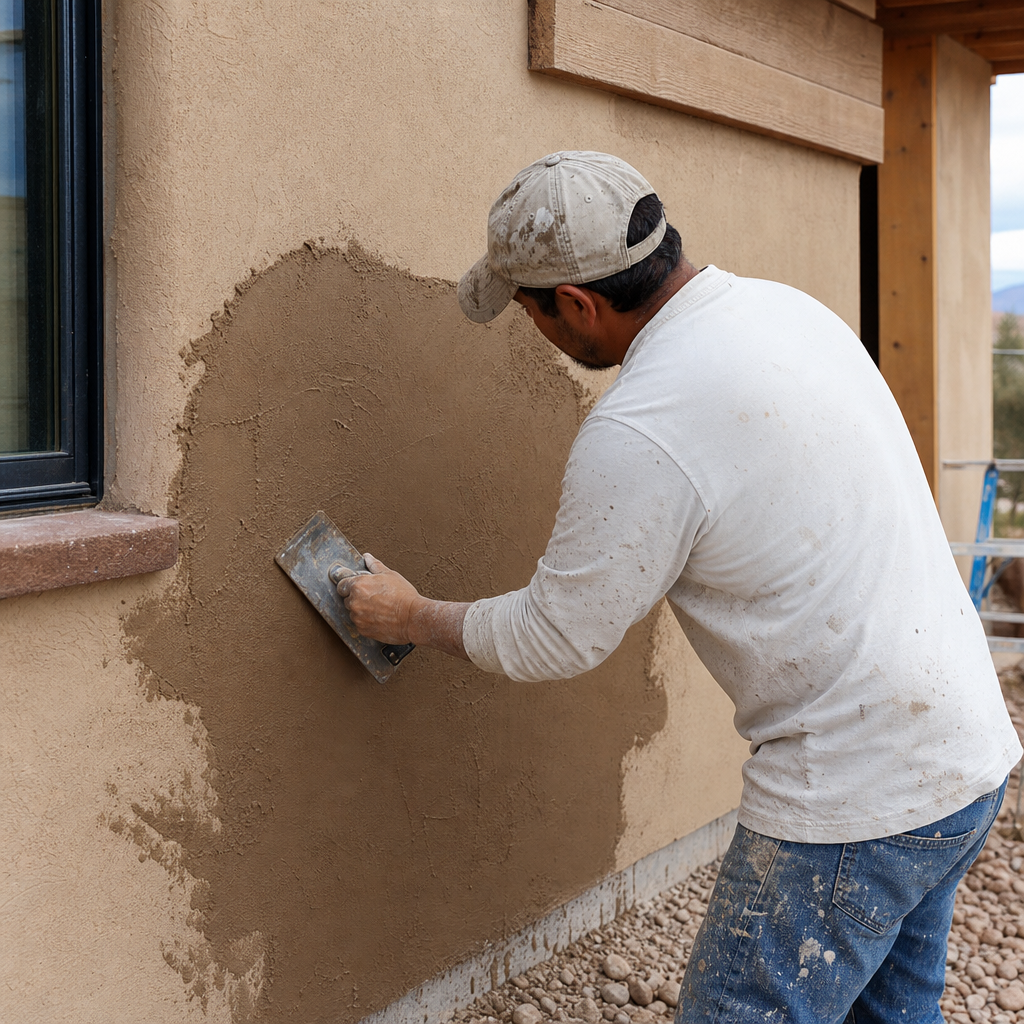
Stucco crack repair in Rio Rancho runs $200–$800 for typical jobs, with larger cracked areas at $8–$20 per square foot. A proper repair cuts the crack back, fills it with material compatible with your stucco system, and refinishes with matched texture and color, so the wall sheds water again instead of drinking it. Send photos of the crack and the wall around it and get a fast flat quote.
Cracks are the number-one stucco call in Rio Rancho, and the reason is geography. This city sits at roughly 5,300 feet of high desert. Walls take intense UV all year, 30–40°F daily temperature swings that flex the finish coat, dozens of freeze-thaw cycles every winter, and then a July–September monsoon that drives rain sideways into whatever opened up. A crack here isn’t static. Every season works on it.
Which cracks actually matter
Not every crack is a problem, and we’d rather tell you that than sell you a repair you don’t need.
Usually cosmetic:
- Map-cracking (craze cracking): a fine spiderweb pattern across the finish coat, common on sun-baked south and west walls. It’s the finish coat aging, not the wall failing. If it bothers you or it’s widespread, the fix is a recoat or elastomeric coating, not forty individual patches.
- Short hairlines under 1/16 inch that don’t line up with openings or the parapet, especially on a newer home still settling.
Worth fixing now:
- Anything a credit card edge fits into. That’s wide enough to take on water, and water at this elevation freezes, expands, and pries the crack wider every winter. Repair cost roughly doubles once the lath behind starts rusting.
- Diagonal cracks off window and door corners. Openings concentrate stress; these cracks often trace back to failed flashing or sealant letting water behind the coat.
- Stair-step or long horizontal cracks: possible movement in the structure, which we flag honestly rather than paper over.
- Any crack on or near a parapet. Flat-roof homes fail from the top down; a parapet crack is a wall-core leak in progress. That’s its own trade. See parapet repair.
- Cracks with company: rust staining, white mineral bloom (efflorescence), or stucco that sounds hollow when tapped. Water’s already been in there. That job is patching, not crack-filling.
Why Rio Rancho homes crack the way they do
One-coat production homes (1990s–2000s) crack faster. Most of Rio Rancho’s boom-era stock, the streets off Southern and Golf Course, Enchanted Hills, Northern Meadows, Cabezon, Loma Colorado, was built with one-coat stucco: a single ~1/2” cement basecoat over foam sheathing. It’s a legitimate system, but it’s roughly half the thickness of traditional three-coat, so thermal movement and settling telegraph through as cracks sooner. If your neighbors’ houses all crack in the same spots, that’s why.
Three-coat homes (pre-2000 and custom) crack old. The original Rio Rancho Estates homes from the 1960s–80s carry thick, durable three-coat cement stucco, but their finish coats are now 40–60 years old, brittle, and often already patched two or three times in mismatched textures. These walls take crack repair well; they just also deserve an honest conversation about whether a recoat is better money.
The newest homes crack young. The building wave that followed Intel’s 2021 expansion announcement put up a lot of houses fast on the city’s northwest edge. Cement stucco shrinks as it cures, and compressed schedules mean some of that shrinkage shows up as cracking at year two or three. It’s usually minor and cheap to fix. The mistake is ignoring it through a couple of monsoons until it isn’t.
How a proper crack repair goes
- Trace the cause first. We follow the crack to its source: settling, a parapet cap, a canale dumping roof water, a sprinkler hitting the wall, stress at an opening. Repairing a symptom without the cause is how the crack comes back with interest.
- Identify your system. Three-coat, one-coat, or EIFS, the repair materials and method depend on it. EIFS cracks in particular must never be filled with cement products.
- Cut back, don’t smear over. The crack is opened to sound material, a proper V-groove or cut-out, not a skim of patch mud across the surface that pops off in a season.
- Fill with compatible material. Cement-based repair for cement systems, packed and worked in stages; flexible sealants only where a joint is supposed to flex.
- Refinish and blend. Texture matched to your wall (sand float, skip trowel, or smooth) and color blended to the weathered surface, judged dry in daylight. Details on color and texture matching.
- Cure respected. Cement work gets its cure time between coats. Rushing this step causes shrinkage cracks, the exact problem you hired out.
When a previous patch covered the weep screed
A crack that came back after someone else repaired it often has a second problem at the bottom of the same wall: the patch was carried straight down over the weep screed. The weep screed is the formed metal or plastic strip along the base of a stucco wall, at or below the foundation plate line. Water that gets through the stucco runs down the paper behind it, and the screed is where it leaves. New Mexico’s residential code (14.7.3 NMAC, the 2021 IRC with state amendments) rewrites section R703.7.2.1 to call for a corrosion-resistant screed of at least 0.019 inch (No. 26 galvanized gage) or plastic, with a vertical attachment flange of at least 3 1/2 inches, set at least 4 inches above the earth or half an inch above paved areas. The water-resistive barrier and the lath both lap that flange. The state’s amended R703.7.2 adds that plaster covers the lath, paper and screed but does not extend below them, and that no plaster is left sitting on the screed.
Bury the screed and water behind the wall has no exit. It collects at the base, soaks the paper, rusts the lath, and the crack above keeps reopening because the wall never dries.
A proper redo cuts the old patch back to a clean screed line and checks the paper and lath behind it. Wet or rusted material comes out, new paper laps over the screed flange, and only then is the crack repaired and the texture matched. Rock or soil piled above the screed is pulled back to restore the clearance. The covered weep screed page covers the other ways a screed gets buried.
Timing: the cheapest crack repair is a spring crack repair
Two dates rule this work in Rio Rancho. The monsoon arrives in July, and nearly half the metro’s annual rain lands between July and September, much of it wind-driven. Every storm that hits an open crack pushes water at the paper and lath behind it. And cement repair work shouldn’t happen in freezing temperatures, which takes chunks of December–February off the table. So the smart window is spring through early summer: the crack is repaired dry, the repair cures in good weather, and the wall meets the monsoon sealed. If you’re calling in October about a crack that leaked in August, you’re normal, but you likely paid a water-damage premium that a May repair would have avoided. Quotes, at least, have no season, photos usually get you a same-day number in any month, so a winter quote with a spring slot is the cheapest path through this whole page.
What it costs
| Job | Typical price |
|---|---|
| One or two typical cracks | $200–$800 |
| Larger cracked areas | $8–$20/sq ft |
| Service minimum | ~$300–$500 |
| Widespread map-cracking (whole elevation) | quoted as coating or recoat |
The variables: crack length and width, wall height and access, your stucco system, and, the big one, whether water already got behind the coat. Done on time, this is the most affordable line of work in the trade; the ranges above assume the water hasn’t had seasons behind the coat. Full context on the pricing page.
Send three photos: the crack close up (with something for scale, a card or a coin), the whole wall, and the roofline or parapet above it. You’ll get back a flat number, the likely cause, and an honest read on whether it’s urgent or can wait for your schedule. We repair cracks across Rio Rancho and out to Corrales, Bernalillo, Placitas, and Albuquerque.
Frequently Asked Questions
How much does stucco crack repair cost in Rio Rancho?
Typical crack repairs run $200–$800; larger cracked areas price at $8–$20 per square foot. Most crews carry a $300–$500 service minimum since even small jobs need mixing, color matching, and a cure-check visit. Photos get you a flat number fast.
Which cracks can I ignore and which need repair?
Fine map-cracking in the finish coat is cosmetic. Repair-worthy: cracks wider than about 1/16 inch (a credit card edge), diagonal cracks off window and door corners, any parapet crack, and cracks with staining or hollow stucco around them. Those take on water, and winter freeze-thaw widens them every year they wait.
Will the repaired crack be invisible?
The texture will blend closely. Color on a sun-faded wall is matched to the weathered surface, not the original chip, and we're honest that older walls show some blend. When invisible matters, a fog coat of the elevation finishes the job, we price that option up front.
Why do my stucco cracks keep coming back?
A returning crack has a moving cause: foundation settling, a working parapet, thermal flexing of a one-coat wall. Filling it a third time won't help. The fix is addressing the movement, or bridging it with a flexible elastomeric coating designed to stretch. We diagnose which before quoting.
Can I caulk stucco cracks myself?
For a true hairline on a wall you plan to recoat anyway, a quality elastomeric sealant beats nothing. But caulk shows badly against stucco texture, and it doesn't rebuild the cement or fix the cause. Wider cracks need to be cut back and refilled with compatible material, a smeared caulk line often makes the eventual proper repair harder.
A previous crack repair covered my weep screed. Does it have to be redone?
Usually the bottom of the patch does. New Mexico's amended code says plaster should cover the weep screed but not extend below it, and that no plaster should be left sitting on it, because the screed is where water behind the stucco drains out. Cutting the patch back to a clean screed line is normally part of a $500 to $2,000 patch job; a concrete slab poured against the screed is scoped on site.